
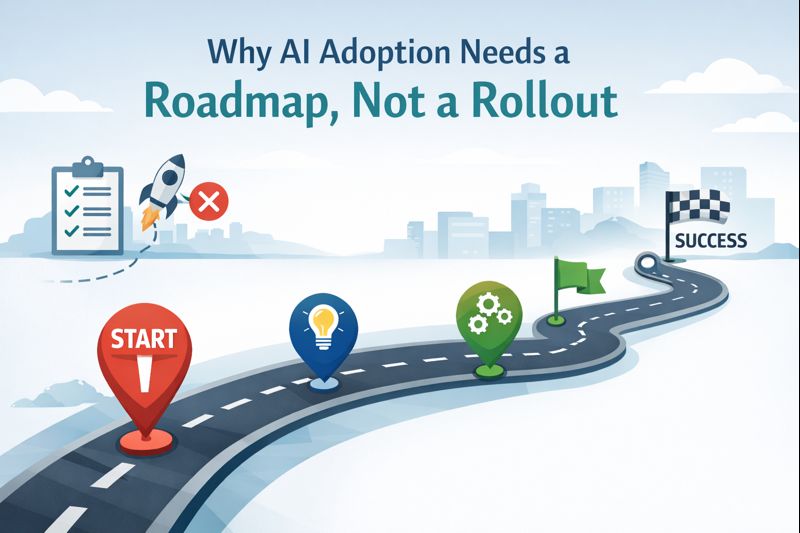
Why AI Adoption Needs a Roadmap, Not a Rollout
Most organizations are trying to roll out AI.
And that’s exactly the problem.
Rollouts work when you’re deploying software.
AI isn’t software — it’s a capability.
You don’t roll out judgment.
You don’t roll out decision-making.
You don’t roll out new ways of working.
You build them.
That distinction — rollout versus roadmap — is often the difference between AI efforts that stall and those that quietly become part of everyday work.
The Problem with Rollout Thinking
Rollout thinking comes from a familiar place.
You pick a tool.
You set a go-live date.
You train everyone.
You hope adoption follows.
That approach can work for systems with predictable behavior.
AI doesn’t behave that way.
When organizations apply rollout thinking to AI, a few things tend to happen quickly:
- The conversation centers on licenses instead of readiness
- Policies show up before value does
- Pilots launch with no clear path to scale
- Leaders start asking, “Is this actually helping anyone?”
What begins with excitement often turns into hesitation.
Not because AI isn’t useful —
but because no one designed how it would be adopted.
AI Adoption Is a Maturity Journey, Not a Launch Event
AI adoption looks much more like a PMO or operating model transformation than a technology deployment.
People don’t all start in the same place.
They don’t move at the same speed.
And they don’t need the same things at the same time.
Some teams are ready to experiment.
Others need guardrails.
Leadership wants evidence.
Security wants clarity.
Finance wants to understand cost and value.
A rollout treats everyone the same.
A roadmap does not.
A roadmap acknowledges reality:
- readiness is uneven
- maturity grows in stages
- confidence must be earned before scale
That’s why AI adoption needs to be sequenced, not launched.
Our Starting Point: Small, Structured, and Real
Every AI adoption journey we support starts the same way — not with a rollout plan, but with a short, structured starting point.
In practice, that usually means a focused, time-boxed effort where a small group works on real workflows, inside the tools they already use, with clear guardrails and leadership visibility.
That early structure is intentional.
It creates enough momentum to learn —
but not so much noise that the organization loses control.
The goal isn’t to prove that AI is impressive.
It’s to prove where it’s useful.
That difference matters more than most organizations expect.
That’s exactly how it works in the AI Starter Program — a practical on-ramp designed to replace open-ended pilots with visible progress and clear next steps.
From That Starting Point Comes the Roadmap
By the time that initial phase ends — however an organization chooses to structure it — the goal is always the same:
Enough real evidence to stop guessing
and start planning what comes next.
That’s where the Role-Based AI Roadmap comes in.
The Role-Based AI Roadmap
The most important outcome of early AI adoption isn’t a demo or a deck.
It’s a Role-Based AI Roadmap — a clear, practical plan that shows what’s ready to scale, what needs more structure, and who owns what next.
Rather than describing a vague future state, the roadmap provides guidance by function, including:
- Leadership & HR
How to sponsor adoption, measure value, and support people through change - Security
Guardrails, approved use categories, and what needs to be in place before scaling - Finance
Cost visibility, license planning, and realistic approaches to ROI - IT & Data
Microsoft 365 readiness, Copilot enablement, and data hygiene priorities - PMO & Strategy
Governance integration, AI-enabled reporting, and benefits tracking - Operations & Teams
Real workflows, repeatable wins, and a sustainable adoption rhythm
The roadmap makes expectations explicit.
It removes guesswork.
And it gives every role a clear next step — not all at once, but in sequence.
Why This Changes the Conversation
Once there’s a roadmap, the conversation shifts.
Leadership stops asking,
“Should we roll this out?”
And starts asking,
“What’s ready to scale next?”
Security moves from blocking to enabling.
Finance moves from skepticism to planning.
Teams stop experimenting in isolation and start sharing patterns.
Nothing about the technology changed.
The adoption design did.
Rollouts Create Activity. Roadmaps Create Capability.
AI initiatives don’t stall because organizations move too slowly.
They stall because they move without a plan for maturity.
A rollout creates a moment.
A roadmap creates momentum.
If your AI efforts feel stuck — or perpetually “almost ready” — the answer probably isn’t another tool, pilot, or policy.
It’s a roadmap that:
- starts small
- proves value in real work
- builds readiness role by role
- and earns the right to scale
That’s how AI becomes part of how work actually gets done —
not just another rollout that looked good at launch.
Next Steps
If you want to see how this roadmap-first approach works in practice, the AI Starter Program shows what it looks like to move from early experimentation to a clear, role-based path forward.