
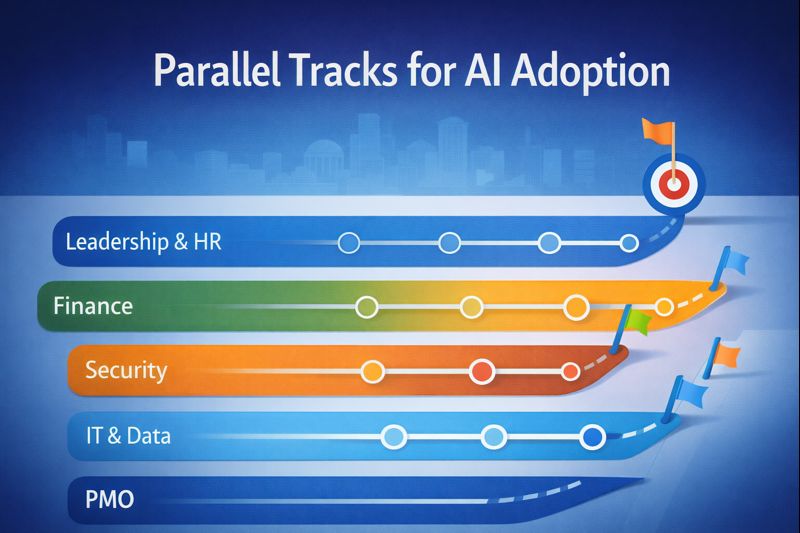
What Leaders Need to See Before Funding AI at Scale
Most leaders aren’t hesitant about AI because they don’t believe in it.
They hesitate because they’ve seen this pattern before.
A new technology shows promise.
Excitement builds quickly.
Budgets get approved early.
And six months later, no one can clearly explain what value actually showed up — or what to fund next.
AI doesn’t feel risky because it’s new.
It feels risky because it’s open-ended.
That’s why leadership support for AI often stalls right at the funding decision.
Why Large AI Funding Decisions Often Fail
When AI funding struggles, it’s usually not because leaders said “no.”
It’s because they were asked to say too big of a yes, too early.
Large, upfront AI investments tend to fail for predictable reasons:
- The scope is unclear
- Value assumptions are theoretical
- Risk feels irreversible once money is committed
- Finance is asked to justify ROI before real usage exists
Leaders don’t like funding exploration.
They like funding direction.
What works better is giving leaders clear options instead of a single, high-stakes decision.
For example:
A. Fund a short, controlled starting phase
Time-boxed, low risk, designed to produce evidence — not transformation.
B. Fund expansion only where value is proven
Scale usage in areas that show real productivity gains, pause the rest.
C. Delay broader investment until readiness gaps are addressed
Security, data quality, or change capacity first — then return to scale.
Those options feel responsible.
They keep funding decisions reversible.
And they give leaders confidence they’re not betting the farm.
How the Starter Program De-Risks the Funding Conversation
This is exactly why we start AI adoption with a short, structured on-ramp rather than a rollout.
In practice, that looks like a focused Starter Program:
- Fixed time window (typically four weeks)
- Small, cross-functional group
- Real workflows, not demos
- Clear guardrails from day one
From a leadership perspective, this matters because it reframes AI funding as:
a controlled investment designed to inform the next decision.
Not a leap of faith.
Instead of asking leaders to believe AI will pay off, the Starter Program produces early signals they can actually react to.
What ROI Looks Like at This Stage (And What It Doesn’t)
One of the biggest mistakes organizations make is trying to calculate full ROI too early.
That’s not realistic — and finance knows it.
What leaders and finance can see early are directional gains, such as:
- 30–60 minutes saved on recurring reports and updates
- 40–50% reduction in meeting prep and follow-up time
- Faster first drafts with better structure and consistency
- Less rework caused by unclear communication
These aren’t theoretical benefits.
They show up in calendars, inboxes, and deliverables.
At this stage, ROI isn’t about precision.
It’s about confidence:
- Is time actually being saved?
- Are people using the tools?
- Is the value repeatable?
That’s enough to fund the next step.
Why Finance Belongs in the Starter Group
This is one of the most important — and most overlooked — aspects of successful AI adoption.
Finance shouldn’t be brought in after pilots to validate ROI.
They should be involved during the early work to understand how value is showing up.
When finance participates in the Starter Program:
- ROI discussions become grounded instead of speculative
- Time savings are understood in context
- Cost and license assumptions are validated early
- Funding conversations feel collaborative, not defensive
Finance doesn’t slow adoption when they’re involved early.
They actually make it easier to scale later — because the story makes sense.
Why Microsoft 365 Context Matters for Leaders
Another reason everyday AI work resonates with leadership is containment.
When AI usage stays inside Microsoft 365 — using existing files, emails, Teams chats, and permissions — leaders see:
- Clear security boundaries
- Predictable cost structures
- Usage tied directly to real work
There’s no separate data universe to manage.
No shadow systems to explain.
And no uncomfortable surprises later.
That containment makes incremental funding possible.
The Role-Based AI Roadmap: Where Leaders and Finance Land
At the end of the Starter Program, the most important output isn’t a demo.
It’s a Role-Based AI Roadmap — and this is where leadership and finance get what they need most.
For leaders, the roadmap shows:
- What’s ready to scale now
- What should wait
- Where sponsorship matters most
- How adoption should progress over time
For finance, the roadmap includes:
- Phased funding recommendations
- Cost visibility tied to real usage
- Value assumptions grounded in observed work
- Clear signals for when to fund, pause, or redirect
This isn’t a generic plan.
It’s a customized decision framework built from actual experience inside the organization.
Funding AI Becomes a Series of Small Yeses
Leaders don’t need certainty to fund AI.
They need safe next steps.
AI scales successfully when:
- funding is incremental
- finance is involved early
- value is visible in everyday work
- roadmaps guide decisions instead of hype
That’s how AI moves from experimentation to capability — without creating anxiety, overspend, or regret.
Not by asking leaders to believe.
But by giving them clear options, grounded evidence, and a roadmap they can stand behind.
Check out our AI Starter Program to get you on the right track.